The decision most homeowners get backwards
Most people pick their quartz first, then try to match it to existing cabinets, or they pick cabinets and countertops at the same time without understanding how they interact. The process that tends to produce better results is: identify your primary visual statement, then coordinate the other materials around it.
If you’re keeping existing cabinets and replacing only the countertops, the cabinet color is your fixed point. Your quartz selection needs to work within that constraint. If you’re doing a full kitchen renovation, the two decisions can be made together, but knowing how the combinations work helps you avoid the most common mismatches seen in San Diego renovation projects.
Undertones matter more than surface color
The most common countertop-to-cabinet mismatch in San Diego kitchens isn’t a value problem (too light or too dark), it’s an undertone problem. White quartz with a cool blue-gray undertone looks wrong against warm cream cabinets because the undertones fight each other.
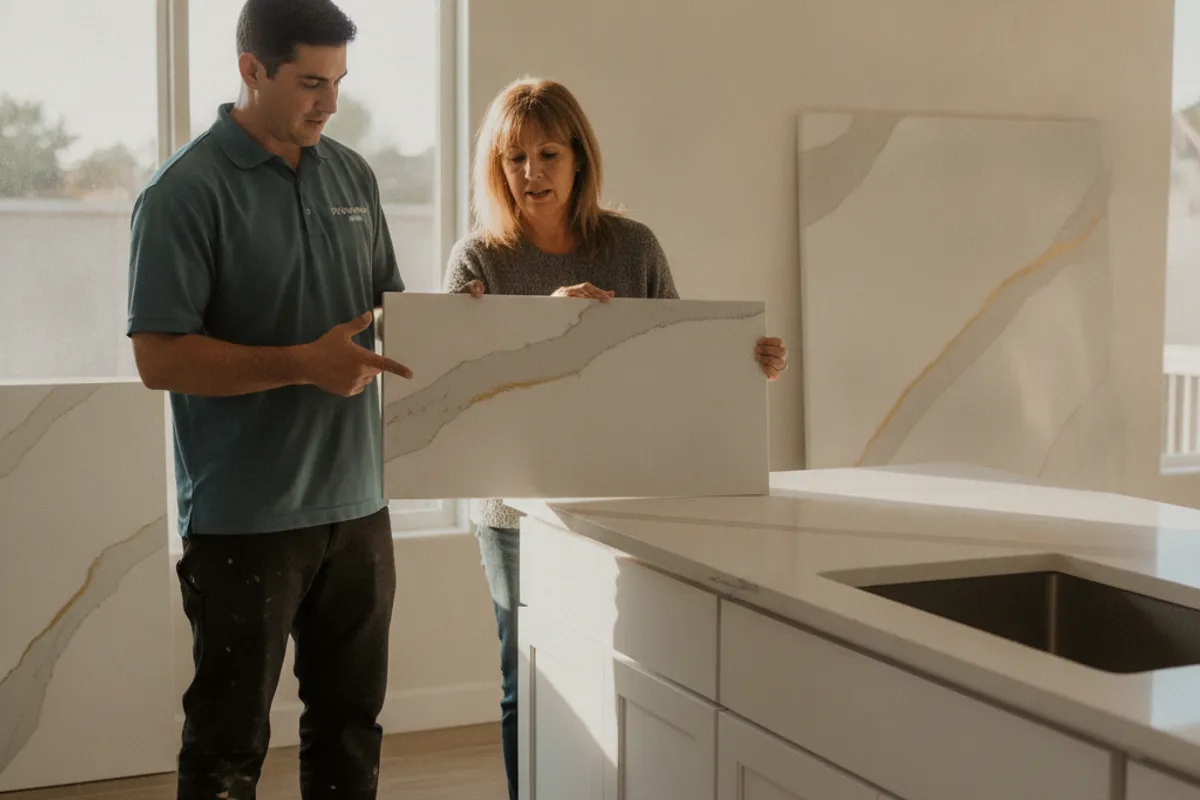
Before bringing a quartz sample home, hold it next to your cabinet door or paint chip in daylight. The surface color may match at a glance. Look at the undertone: does the quartz have warm cream, beige, or gold tones? Or does it have cool gray, blue, or green tones? Your cabinet color has undertones too. When they align, the combination feels cohesive even if the colors are very different in value.
The most common cabinet and countertop combinations in San Diego
White or off-white cabinets + white or light gray quartz: The dominant combination in San Diego kitchens built or renovated in the past decade. It reads as light, clean, and works with both coastal and contemporary design directions. The key is making sure the white in the quartz doesn’t clash with the white of the cabinet. Bring a door sample to the slab yard. Bright white quartz next to a warm antique white cabinet looks jarring.
White shaker cabinets + veined quartz: White cabinets with strong veining in the quartz (gray veins on white, or dramatic Calacatta-style black veining) create visual contrast and give the countertop a focal role. Common in Encinitas, Carlsbad, and Del Mar coastal homes. This works best when the veining is deliberate and the rest of the kitchen is otherwise restrained.
Navy or dark blue cabinets + light quartz: A popular combination in San Diego’s coastal homes. Light quartz, particularly white or very light gray, provides the contrast that makes dark cabinets dramatic rather than heavy. The quartz undertone should coordinate with the hardware finish (warm gold hardware usually calls for quartz with warm undertones; brushed nickel or matte black hardware reads better with cool-undertone quartz).
Gray cabinets + white or light quartz: A transitional combination that’s remained popular because it’s easy to live with. Warm gray cabinets need quartz with warm undertones. Cool gray (blue-gray) cabinets coordinate with cooler quartz. The gray cabinet, if it’s mid-value, can support either a lighter quartz for contrast or a slightly darker quartz for a more restrained tonal look.
Warm wood or wood-look cabinets + white or cream quartz: This is a San Diego-specific combination that bridges the organic warmth of wood with a clean countertop material. The quartz should have warm or neutral undertones, not cool ones. A stark cool-white quartz next to warm walnut or natural oak cabinets will look cold and disconnected.
Two-tone cabinet setups
Two-tone kitchens (dark lower cabinets, white upper cabinets or vice versa) are common in San Diego new construction and renovations. The countertop sits at the boundary of the two colors, so it needs to work with both.
The most reliable approach for two-tone setups: choose a quartz that reads as mid-value, with enough complexity (veining, movement) that it bridges the two cabinet colors. A solid-color quartz that matches one cabinet but ignores the other often looks like a mistake.
The countertop color should not fight for dominance in a two-tone kitchen. The cabinet contrast is already the visual statement. The countertop’s role is to be the functional, attractive surface that connects the two colors.
What doesn’t work
Matching value without controlling undertone: Same brightness, wrong temperature. Warm-undertone white quartz on cool-white cabinets looks like two different materials that weren’t coordinated.
High contrast everywhere: Dark cabinets plus dramatic veined quartz plus a busy tile backsplash plus patterned flooring. San Diego kitchens that look great in photos usually have visual rest somewhere. The countertop, the backsplash, or the cabinet doors needs to be restrained.
Choosing quartz from a small sample under store lighting: The slab yard lighting is controlled to make slabs look their best. Your kitchen is lit differently. Bring the largest sample you can get into your actual kitchen under your actual lighting before committing.
Backsplash as the third element
The backsplash connects the countertop to the wall and upper cabinets. In most San Diego kitchens, the backsplash is either an extension of the countertop material (quartz backsplash, continuous with the counter), a simple tile that coordinates with the quartz pattern, or a contrasting material that ties the room together.
If you’re choosing the backsplash at the same time as the quartz, the sequence is: confirm the quartz, then choose the backsplash to coordinate with it. Both materials need to work with the cabinet color. A backsplash that works with the quartz but not the cabinets creates a disconnected section of the kitchen.
For a look at full installation scope including quartz backsplash options, see the countertop installation service page.
Getting it right
The most reliable way to confirm a combination works is to bring home samples of the quartz alongside the cabinet sample and the wall surface material, and look at them together in your kitchen at different times of day. Natural light in the morning, afternoon sun through west-facing windows, and evening kitchen lighting all affect how the combination reads.
Call (858) 925-5546 to get connected with a San Diego countertop fabricator who can help you work through your material selection and bring samples to your home.
How do I match quartz to white cabinets?
Pay attention to undertone, not just brightness. Warm off-white cabinets call for quartz with warm or neutral undertones. Cool bright-white cabinets coordinate with cooler-undertone quartz. Bring a cabinet door or paint chip to the slab yard and compare them in natural light.
Should the countertop match or contrast with the cabinets?
Both approaches work. Contrast (light countertop on dark cabinets, or vice versa) creates visual interest and makes the countertop a design element. Tonal coordination (similar values with aligned undertones) creates a calmer, more unified look. The choice depends on the design direction of the kitchen.
What quartz color works with dark navy cabinets?
Light quartz, particularly white or light gray, creates the contrast that makes dark navy cabinets stand out. The quartz undertone should coordinate with your hardware finish. Warm brushed gold hardware reads better with quartz that has warm or neutral undertones; matte black or brushed nickel works with cooler-undertone quartz.