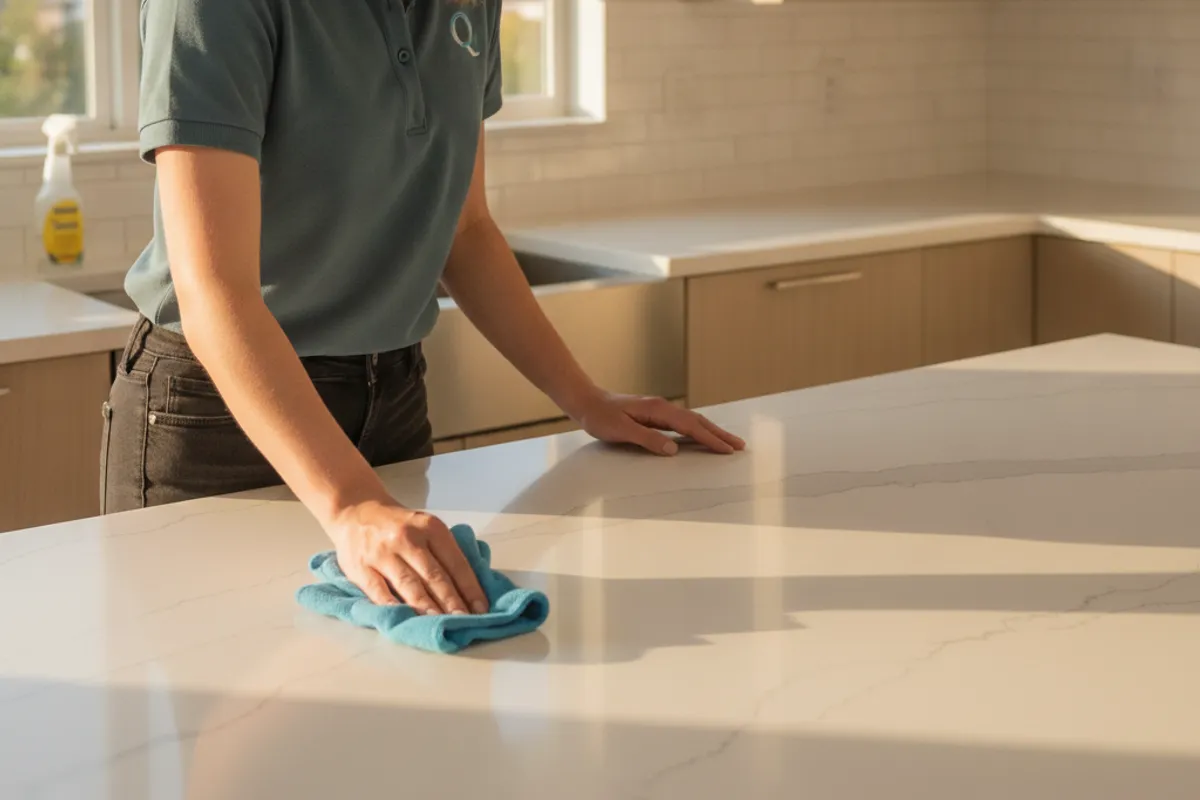
Why quartz maintenance is simpler than most stone
One of the main reasons homeowners choose quartz over granite or marble is the maintenance profile. Quartz is non-porous. The resin binder seals the surface at the manufacturing level, which means no sealing, no annual maintenance treatments, and no need to worry about liquids soaking in while you’re making coffee.
What you do need to manage: the limits of the resin binder. Quartz handles most kitchen use without any issues. A few specific products and situations can cause damage that is irreversible.
This guide covers the daily routine, the stain scenarios that come up, the products to avoid, and the few real risks worth knowing about.
Daily cleaning
Soap and water is the correct answer for daily quartz countertop cleaning. Dish soap diluted in warm water, applied with a soft cloth or sponge, removed with a rinse cloth. That’s it.
For drying: quartz doesn’t require drying to prevent water spots the way some natural stone does, but in San Diego’s coastal areas where mineral-heavy water causes spots on glass and fixtures, you may notice faint water marks on polished quartz near the sink area. A quick dry with a microfiber cloth after washing eliminates this.
Paper towels work for quick wipe-downs. Avoid abrasive scouring pads, steel wool, or textured scrub pads. They won’t scratch quartz (quartz is hard) but over time they can dull the polish on the surface.
Cleaning products that are safe on quartz
- Dish soap and water (best everyday option)
- Mild all-purpose cleaners (Simple Green, Method)
- pH-neutral stone cleaners (sold at countertop showrooms)
- Diluted rubbing alcohol (70%) for disinfecting
The product list is intentionally short. Quartz doesn’t need anything special to clean. More is not better here.
Products to avoid
This is the more important list.
Bleach: Undiluted bleach can discolor quartz and damage the resin surface. Some homeowners dilute bleach for disinfecting and apply it briefly, but the manufacturer recommendation from most brands is to avoid bleach entirely. If you need disinfection, 70% isopropyl alcohol is effective and safe.
Abrasive cleaners: Bar Keepers Friend, Comet, Ajax, and similar powder or cream cleansers contain abrasive particles that dull the polished surface over time. They are safe on hardier surfaces but not on polished quartz.
Acidic cleaners: Vinegar, lemon juice-based cleaners, and any cleaner with a low pH can degrade the resin surface with repeated use. This is less acute on quartz than on marble (which etches dramatically with acid) but still a concern over time.
Oven cleaners: Highly alkaline. Never use oven cleaner on quartz.
Paint removers and solvents: Acetone-based products (nail polish remover), paint strippers, and similar solvents can damage the resin. If you accidentally get paint or adhesive on the surface, use a plastic scraper and then a gentle cleaner rather than a solvent.
Handling common stains
Coffee and tea: These are the most common countertop stains in San Diego kitchens. Fresh spills wipe up with soap and water. Dried coffee stains usually respond to a damp cloth with dish soap and gentle pressure. If the stain has been sitting for a few hours, a small amount of diluted isopropyl alcohol on a cloth usually removes it.
Wine and juice: Same approach as coffee. Fresh is easy. Dried stains take a bit more effort with soap and water. Don’t use vinegar or citrus-based cleaners as a stain remover on quartz.
Cooking oil and grease: Dish soap is specifically designed for this. Apply, let sit for a minute, scrub gently, rinse.
Permanent marker: Rubbing alcohol (70% isopropyl) usually removes permanent marker from quartz. Apply to a cloth, not directly to the counter, and rub in a circular motion.
Dried food: A plastic scraper (not a metal blade) to lift the bulk of dried food, then soap and water for the residue. Don’t use a metal scraper or blade on polished quartz.
Heat protection (the main risk)
As covered in the heat resistance guide, sustained high heat from a very hot pan placed directly on quartz can damage the resin. Always use a trivet. This is the single most important maintenance habit for quartz countertops.
See the full explanation in the quartz countertop heat resistance guide.
What “sealed” means (and why quartz doesn’t need it)
Granite and natural stone are sealed with a penetrating sealer that fills the pores and prevents liquids from absorbing into the stone. Quartz doesn’t have open pores, so there’s nothing for the sealer to do. The factory-bonded resin performs that function permanently.
If a salesperson or contractor suggests sealing your quartz countertops, decline. It won’t help, and some sealers can create a residue or uneven sheen on quartz. This advice applies to any engineered quartz product regardless of brand.
Quartz in San Diego’s coastal environment
Salt air and marine layer humidity in coastal San Diego neighborhoods like Ocean Beach, Point Loma, and Coronado don’t affect interior quartz countertops. The non-porous surface doesn’t respond to humidity the way wood or natural stone sometimes does. Interior quartz in coastal homes requires the same care as quartz anywhere else in the county.
Outdoor quartz is a different situation. UV exposure degrades the resin, and outdoor quartz in direct San Diego sun will fade over time. See the quartz vs granite guide for outdoor countertop material options.
Long-term care: what to expect after years of use
Properly maintained quartz countertops in San Diego kitchens look essentially the same after 10 years as they did on installation day. The non-porous surface doesn’t develop the staining or etching that marble and unsealed granite accumulate over time. The main thing that changes is the polish in areas of very heavy daily use, which can develop a slight matte appearance from micro-abrasion over years of use. This is very gradual and not typically an issue in normal residential kitchens.
Call (858) 925-5546 to speak with a San Diego countertop specialist. We connect you with insured local fabricators who can answer care questions specific to the product you’re considering.
Do quartz countertops need to be sealed?
No. Quartz is non-porous and does not require sealing. The resin binder creates a permanently sealed surface. Sealing quartz provides no benefit and may leave residue.
How do you remove stains from quartz countertops?
Most quartz stains respond to dish soap and warm water. For dried or stubborn stains, diluted isopropyl alcohol (70%) usually works. Avoid acidic cleaners like vinegar, bleach, or abrasive powder cleansers.
Can I use bleach to clean quartz countertops?
Most quartz manufacturers recommend against bleach. It can discolor the resin surface and damage the finish. Use diluted isopropyl alcohol for disinfecting instead.