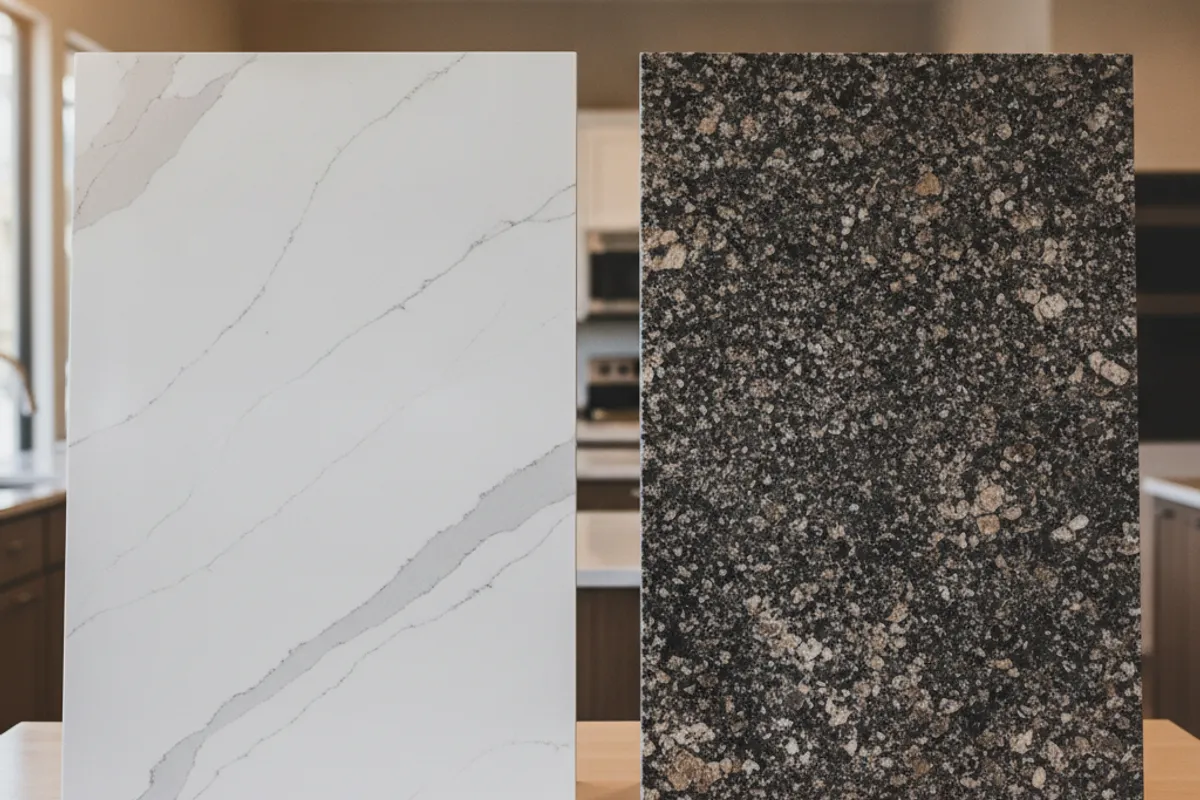
Two materials, different strengths
Quartz and granite are both stone countertops, and both are durable enough for a busy kitchen. The differences that actually matter for a San Diego homeowner come down to porosity, maintenance habits, and what you want the surface to look like in five years.
This is not a competition with a winner. It’s a choice between two materials with genuinely different characteristics. The right one depends on your kitchen use, your household habits, and the look you’re after.
What each material is
Granite is a natural stone quarried in large slabs. Every slab is unique. The colors, veining, and patterns are formed by geology over millions of years. A granite countertop in a Solana Beach home is a different slab from the one in a Chula Vista kitchen even if they came from the same quarry run.
Quartz countertops are engineered stone. Manufacturers bind crushed quartz (90-95% of the material) with resin under heat and pressure. The result is a uniform, non-porous slab. The color and pattern are controlled, so you can get consistent veining across a large kitchen and match slabs exactly when you need multiple pieces.
Porosity and maintenance
This is where the practical difference is sharpest.
Granite is porous. It absorbs liquids if it isn’t sealed regularly. Red wine, coffee, and cooking oils can stain granite if they sit on the surface. Most installers recommend sealing granite at installation and re-sealing every 1-3 years depending on use. The sealing process is simple but it’s a maintenance task that exists with granite and doesn’t exist with quartz.
Quartz is non-porous. The resin in engineered quartz fills the gaps between crushed stone particles, creating a surface that doesn’t absorb liquids. You don’t need to seal quartz. A wet sponge and dish soap is the standard cleaning method.
For San Diego kitchens that see heavy use, the non-porous nature of quartz is a genuine convenience. For homeowners who prefer natural stone and are willing to maintain a seal, granite performs well.
Durability
Both materials are hard and scratch-resistant for everyday kitchen use. Quartz rates 7 on the Mohs hardness scale; granite ranges from 6 to 8 depending on the specific stone. In practical terms, neither will scratch under normal use. You shouldn’t cut directly on either surface not because of the stone, but because doing so dulls your knives.
Where quartz has a known limitation: heat. The resin binder in quartz can discolor or crack if a very hot pan is placed directly on the surface. Granite handles heat better because it’s all-natural stone. Neither material should be used as a trivet routinely, but if you forget occasionally, granite is more forgiving.
Quartz also chips at the corners and edges more predictably than granite when impacted. Granite tends to fracture along natural fissures. Both can chip; the fracture pattern just differs.
For more on heat resistance specifically, see the quartz countertop heat resistance guide.
Appearance
Granite’s natural variation is either its best feature or its biggest challenge, depending on your perspective. No two slabs look identical. The veining runs in the direction the stone formed underground, so it can be unpredictable. In a large kitchen with multiple slab sections, matching the pattern at seams is difficult. Fabricators work with what the stone gives them.
Quartz gives you control. You can specify the exact colorway, the vein direction, and the pattern density. If you’re trying to replicate a specific marble look (popular in San Diego kitchens right now), quartz gives you a consistent result that natural marble can’t.
Both are available in an enormous range of colors. Quartz dominates in whites and grays because those looks are hard to achieve consistently in natural stone.
Cost comparison in San Diego
Entry-level granite and mid-grade quartz land in a similar price range: $55-$85 per square foot installed in San Diego County. Premium quartz with designer veining runs $80-$120 per square foot. High-end exotic granite slabs can exceed $100 per square foot, though common granite colors are often less expensive than premium quartz.
The maintenance cost difference is minor. Granite sealer costs $15-$40 per application and takes 30 minutes every year or two. It’s not a significant expense but it’s a recurring one.
Coastal San Diego considerations
The marine layer along the coast and the salt air in neighborhoods like Ocean Beach, Pacific Beach, and La Jolla don’t affect either material at the countertop level. Both perform well in coastal homes.
Outdoors is a different situation. Quartz is not recommended for outdoor kitchens exposed to direct sunlight. The UV exposure degrades the resin binder and causes color fading over time. Granite holds up outdoors because it has no resin. If you’re planning an outdoor kitchen in Encinitas or Rancho Santa Fe, granite is the more durable choice for that application.
Which one to choose
Choose quartz if: you want low maintenance, consistent appearance, or a specific modern look with controlled veining. Quartz is the default recommendation for most San Diego kitchens because of the no-seal maintenance profile and the visual flexibility.
Choose granite if: you prefer natural stone, you want the unique character that comes from a one-of-a-kind slab, or you’re installing outdoor countertops. Granite is also the better call if your household regularly places hot pans on the counter.
Either way, the decision starts with seeing slabs in person. Material samples look different under showroom lighting than in your kitchen. Request samples and bring them home before committing.
Call (858) 925-5546 to talk through the options with a San Diego countertop specialist. We connect you with insured local fabricators who can walk you through both materials and get you a quote for your specific kitchen.
Is quartz more expensive than granite in San Diego?
At the mid-range, they’re similar. Entry-level quartz and common granite colors run $55-$85 per square foot installed. Premium designer quartz often costs more than mid-grade granite. Exotic granite can exceed premium quartz at the high end.
Does quartz need to be sealed?
No. Quartz is non-porous and does not require sealing. Granite does require periodic sealing, typically every 1-3 years depending on use.
Can quartz be used for an outdoor kitchen in San Diego?
Quartz is not recommended for outdoor kitchens in direct sunlight. UV exposure degrades the resin binder and causes fading. Granite is the better outdoor countertop material.