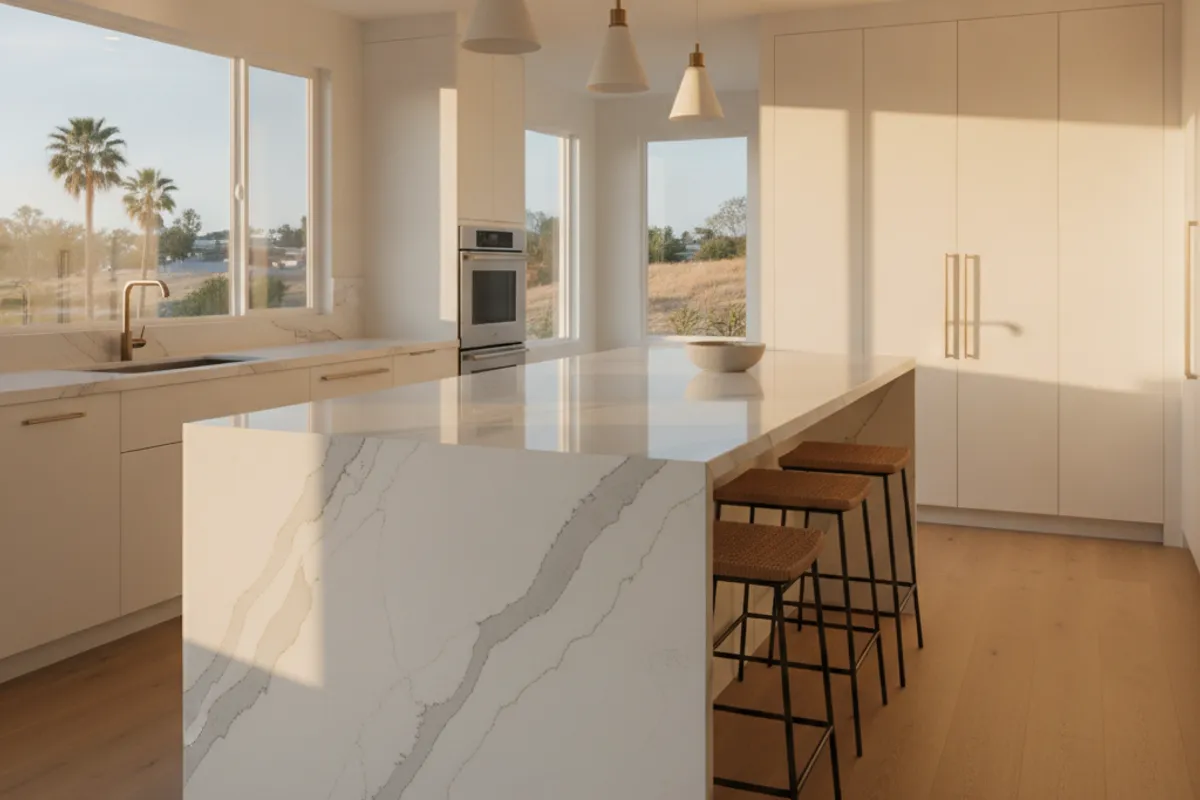
What a waterfall countertop actually is
A waterfall countertop extends the horizontal counter surface vertically down the side of the island or cabinet, all the way to the floor. The stone appears to “fall” from the countertop to the floor in a continuous panel. When done with veined material and careful vein matching, the waterfall creates a dramatic visual where the stone pattern wraps around the corner in a continuous flow.
Waterfall countertops have become a signature feature in high-end San Diego kitchen remodels, particularly in coastal communities and newer construction in Rancho Santa Fe, Del Mar, and La Jolla. They work in modern and transitional kitchens. They look out of place in heavily traditional or farmhouse designs.
The three types of waterfall installations
Not all waterfalls are the same fabrication job.
Single-side waterfall: One vertical panel drops from the countertop on one end of the island. This is the most common configuration. It reads as a design accent without dominating the space.
Double-side waterfall: Both ends of the island have vertical panels. This is a stronger statement and requires more material. It also requires more careful balancing of the visual weight of the stone.
Full wrap: In some installations, the waterfall wraps around a corner at the base of the island. This is the most complex fabrication and the most expensive option.
How fabricators match the vein pattern
The visual payoff of a waterfall depends on how well the vein continues from the horizontal countertop to the vertical panel. There are two approaches.
Bookmatch: The fabricator cuts two consecutive slices from the same block of stone, then mirrors them at the miter joint. Because the two pieces are adjacent cuts, the veining flows across the seam with a mirrored symmetry. This requires sourcing two matched slabs from the same production run, which adds material cost and sometimes requires checking multiple slab lots.
Continuous vein match: With engineered quartz in designs with linear veining (like a white quartz with straight gray veins), the fabricator orients the horizontal and vertical pieces so the veins appear to continue around the corner. This is geometry rather than matching, and it works well for linear patterns. It doesn’t work for random natural-stone vein patterns.
With true natural stone like marble or quartzite, bookmatching is the standard approach for a serious waterfall. With engineered quartz, the orientation approach often gives a good result at lower material cost.
What it costs in San Diego
A waterfall side panel adds roughly $800-$2,500 per side to the cost of the island countertop, depending on:
- Square footage of the vertical panel (the height of the cabinet times the depth of the island)
- Material choice (premium quartz or natural stone runs higher)
- Whether bookmatching or vein matching is required
- The complexity of the miter joint
A standard kitchen island that is 4 feet wide and 36 inches tall has roughly 12 square feet of vertical panel per side. At typical San Diego fabrication rates, add $800-$1,500 per side for a single-material quartz waterfall, or $1,500-$2,500 per side if bookmatching natural stone.
A two-sided waterfall on a mid-size island with quality quartz typically adds $2,000-$4,500 to the island countertop cost.
The miter joint
The corner where the horizontal countertop meets the vertical panel is a miter joint. Both pieces are cut at a 45-degree angle and joined so the seam is a thin line at the outside corner. The quality of this joint is the defining visual element of the waterfall. A well-cut miter with good vein alignment is nearly invisible at a few feet away. A poorly cut miter with a gap or misaligned pattern is the first thing you see.
This is where fabricator skill genuinely matters. Ask to see examples of completed waterfall installations before committing to a fabricator. Most San Diego fabricators who do this work regularly have photos.
Practical considerations
Cleaning: The vertical panel catches drips and scuffs from cabinet doors and stools. It requires the same care as the countertop surface.
Toe kick: In a standard island installation, there’s a recessed toe kick at the base. With a full waterfall to the floor, you need to decide how the panel meets the floor: either continue to the finished floor surface (no toe kick), or build a small base platform. Most designers opt for a 4-inch reveal at the base, which avoids the panel touching the floor directly.
Cabinet modification: The island cabinet typically needs a finished end panel removed or reconfigured to allow the stone to sit flush against the cabinet side. Confirm with your cabinet maker before fabrication.
Structural support: A 3 cm quartz panel running floor-to-countertop height needs adhesive to the cabinet and may benefit from a hidden support bracket at the top of the panel, particularly for very tall panels. Ask your fabricator how they secure the waterfall panel.
For overall installation process information, see the countertop installation guide.
Whether it’s right for your kitchen
The waterfall countertop is a design statement, not a functional feature. It doesn’t make the countertop more durable or easier to use. It costs more material and more fabrication time. The payoff is purely visual.
It’s the right choice if: you have a modern or transitional kitchen, the island is the focal point of the space, and you want a finished architectural look that stands out.
It’s the wrong choice if: your kitchen has a different design direction, you’re working with a tight budget and the money is better spent on the slab quality or other features, or the island location makes the vertical panel hard to see from the main living area anyway.
Call (858) 925-5546 to talk through your island design with a San Diego countertop specialist. We connect you with insured fabricators who have completed waterfall installations across San Diego County and can show you examples of their work.
How much does a waterfall countertop add to the cost?
A waterfall side panel typically adds $800-$2,500 per side in San Diego, depending on material, panel size, and whether bookmatching is needed. A two-sided waterfall on a mid-size island adds roughly $2,000-$4,500 to the island countertop cost.
What is a bookmatched waterfall countertop?
Bookmatching means the fabricator uses two adjacent slab cuts mirrored at the miter joint so the vein pattern flows continuously around the corner. It requires sourcing matched slabs and adds material and fabrication cost compared to a standard orientation match.
Does a waterfall countertop go all the way to the floor?
Yes, a true waterfall panel runs from the countertop surface to the floor. Most installations include a small reveal at the base (typically 4 inches) rather than touching the floor directly, which keeps the panel from contacting foot traffic and makes cleaning easier.